
This blog is a follow up to a previous one where I used structural linguistics and Landauer heat to do some estimates of how many Floating Point Operations per second (FLOPS) the human brain was capable of. Using this estimate as a benchmark for AI timelines, that is to identify the point at which AI will be capable of general human level intellectual tasks, becomes trivial if we extrapolate from a few hardware trends, so I’ll present the resulting timelines here.
First, however, I need to amend some errors I made in the first post regarding my calculations based on Landauer heat. My calculations, based on the isobaric specific heat capacity of water, were incorrect as this was basically calculating the one time energy expenditure required to heat up water with the mass of the brain 1 degree kelvin, which 1) did not put the energy into units of time, and 2) did not account for the fact that the brain is 1 degree kelvin warmer as a part of a stable homeostasis. To fix this, we can instead use Newton’s Law of Cooling: where the power output by a body hotter than its environment (and therefore the required replacement power to keep it hot) is equal to the heat transfer coefficient multiplied by the temperature difference.
According to one estimate,1 the heat transfer coefficient of the brain is (4.18 )* 10^-3 W/(cm^2*°C), or, to make the units easier, 2.732 W/(m^2*°K). The brain has a surface area of 20 m^22, and the temperature difference was 1 K, so we just multiply 2.732*20 to get the amount of Watts, which would be 54.64, much more reasonable than the implicitly assumed 5,747.5 watts we got last time (watts are joules per second). Converting this to logical operations per second via the 3.4 * 10^-21 joules per AND gate operations, we get 1.6*10^22 logical operations per second, about two orders of magnitude less than before.
Now, I think there’s a second error that was made doing the Landauer heat calculations. When converting logical operations to FLOPS, I took the ratio of logical operations to FLOPS found in a datacenter GPU as the same ratio we should expect in the human body (200,000 to 1), but this might not be the best approach. Human brains are probably optimized to use as few logical operations as possible to achieve intellectual work in a way current gen GPUs probably aren’t. Let’s instead figure out what the smallest possible amount of logical operations are required to do a floating point operation.
There are 32 bits in a floating point number, and to add two floating point numbers would therefore require a circuit of one half adder and 31 full adders,3 which, if we could take a XOR gate as 5 AND gates4 in terms of Landauer heat, would come to 409 logical operations per FLOP. Therefore our new Landauer heat based estimate of human compute would be:
Human FLOPS = 1.6*10^22 / 409
Human FLOPS = 3.9*10^19
Compare this to our structural linguistics based estimate of 7 * 10^19 FLOPS and the range has gotten even tighter than before (our original Landauer based estimate was 8.5 * 10 ^ 18 FLOPS). Both the Landauer and the structural linguistics based estimates should be taken as guesses about the upper bound of human compute, the Landauer estimate because heat can be produced from other sources other than compute in the brain, and the structural linguistics based estimate because potentially there are compute saving techniques one could use by compartmentalizing the meaning of certain signs away from the meanings of others, say, having several semiotic fields instead of having one big one.
This means that once the computational capacity of computers equals or exceeds this range of 3.9 10^19 to 7 * 10^19 FLOPS, we can be somewhat confident that the hardware problem of achieving human level AI will be more or less solved. Applying these estimates of human compute to the empirical record of cutting edge super computers,5 we’ll see that the trendline for super computer FLOPS will surpass the Landauer based estimate in 2030, and the structural linguistics estimate in 2031. See the graph below.
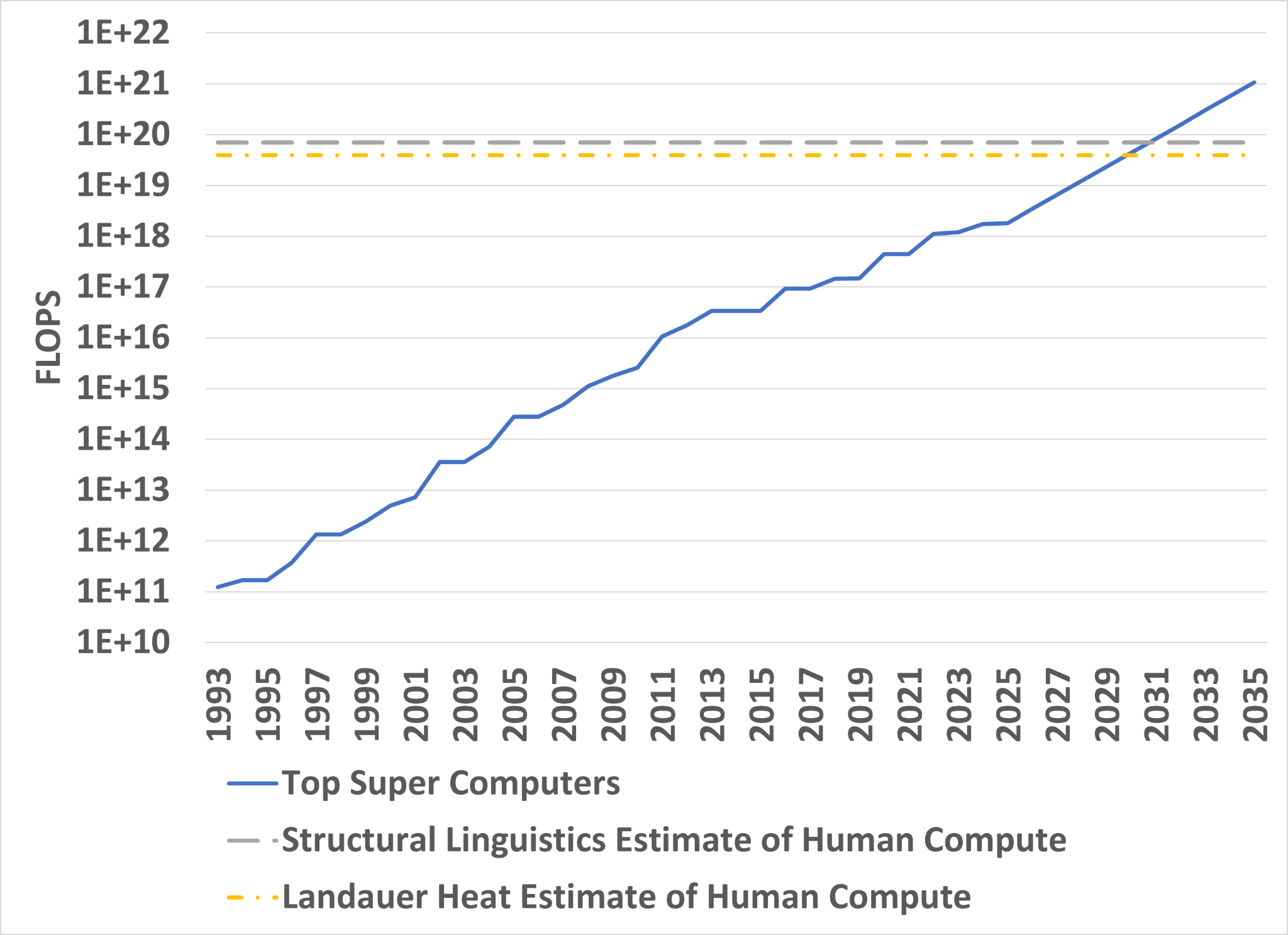
This gives us a very neat window for when the most advanced computers will have the technical capability to equal or surpass human intelligence. About 4-5 years from now.
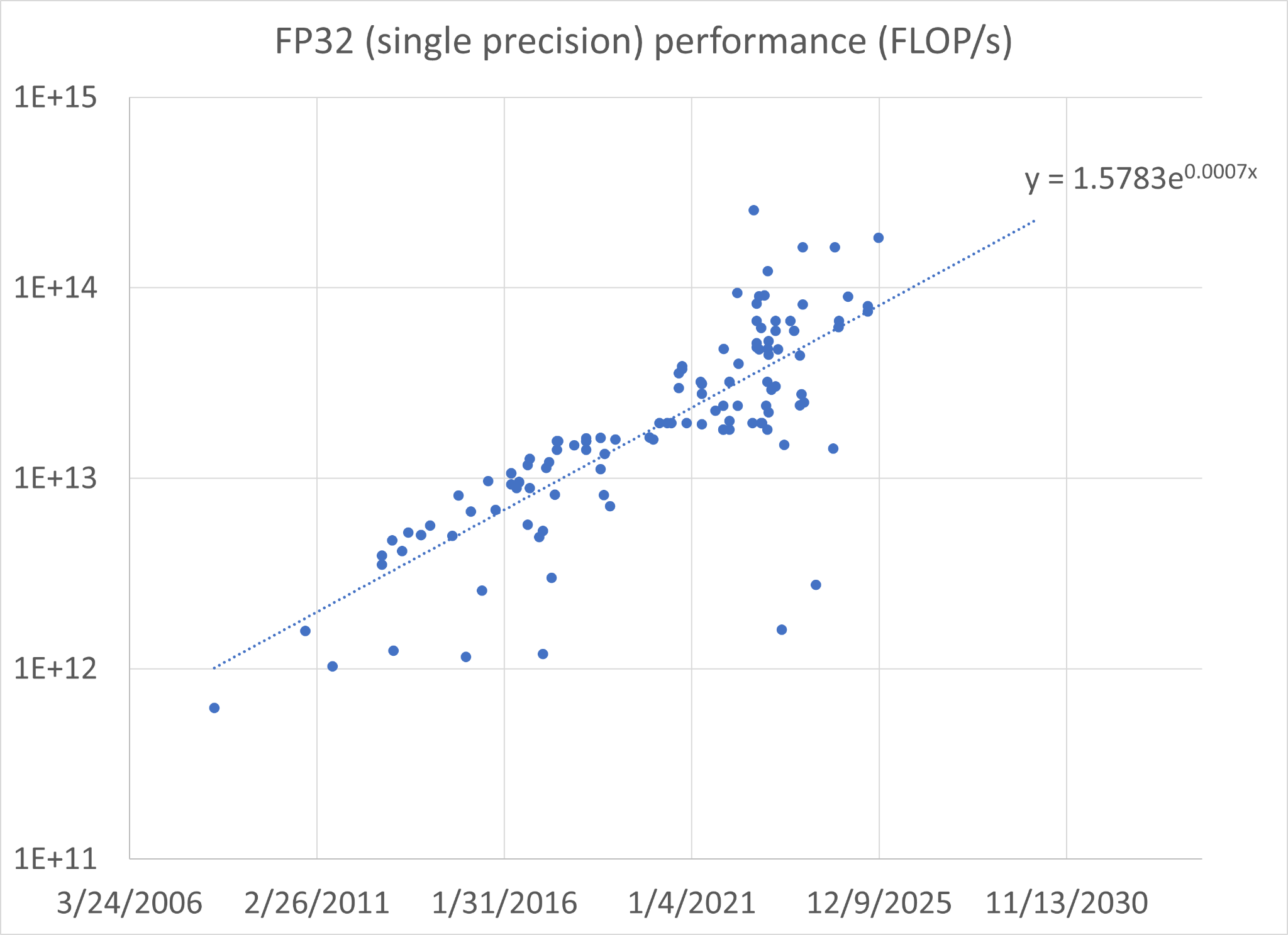
But top supercomputers are a big step up from the hardware that’s used for commercial machine learning training today. In fact, such ordinary hardware is about 4 orders of magnitude behind these top supercomputers in FLOPS.
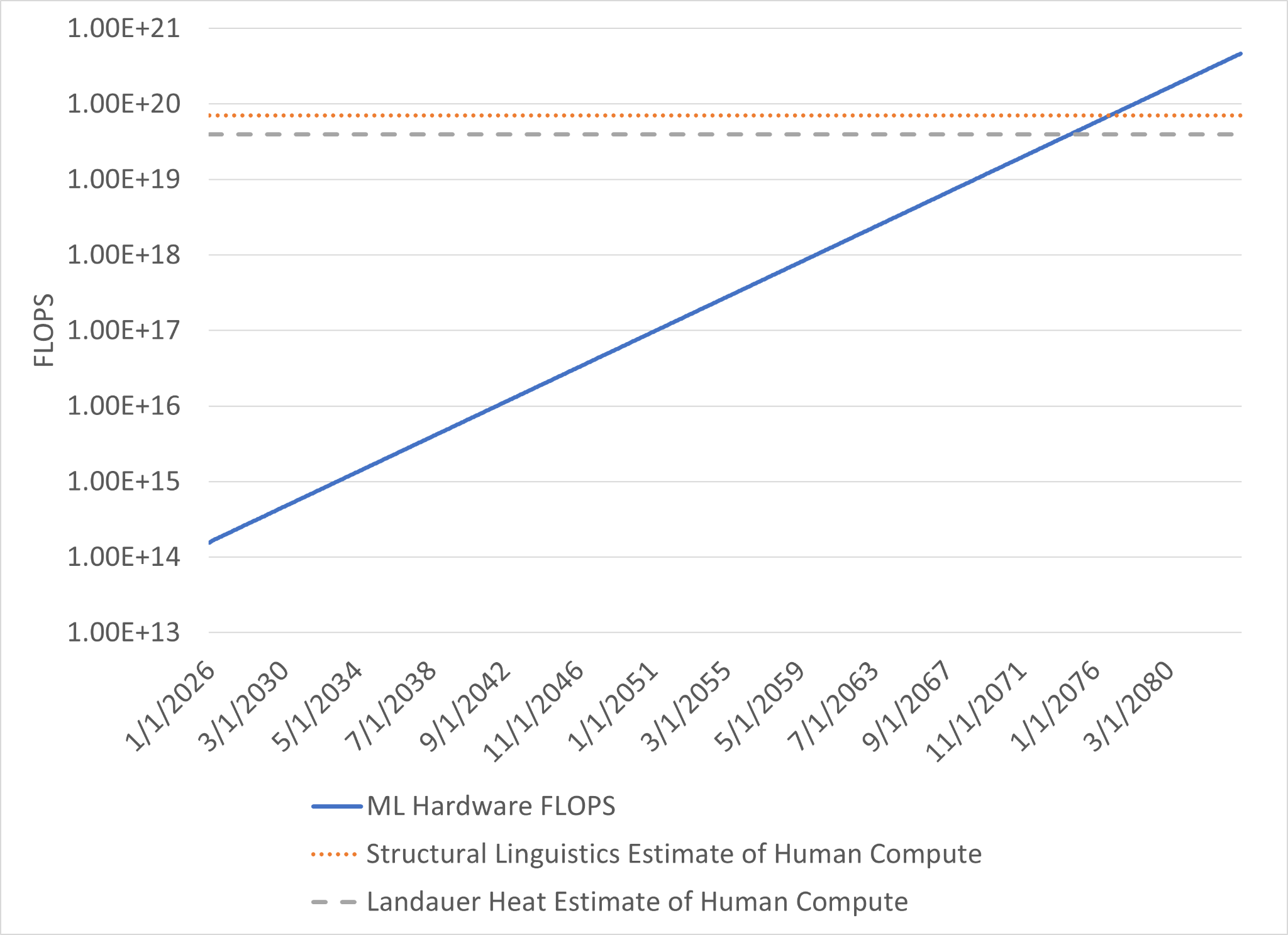
Therefore, if we extrapolate the exponential curve in the graph above outwards, it would take until roughly 2077 for commercial machine learning hardware to achieve human level AI, a timeline of 50 years. The middle of the 21st century, if these forecasts are accurate, would be a very peculiar place, a sputtering and halting arrival of a truly universal machine.
This would still be contingent on a software that would make this possible. Simply scaling up current LLMs will not work for creating an intelligence which is fully substitutable for humans, regardless of what sort of real world data is included in training or how much. An LLM is essentially a static semiotic field being queried, meaning that it only knows the meanings of all the signs it knows based on that one snapshot of meanings given in its training data. The sort of in-context learning LLM based AIs can do now is necessarily based on extrapolating the meaning of unknown signs via known signs. When linguistic evolution happens, the meaning of all signs begins to shift, some more than others of course, but each linguistic shift will have some impact on the other signs. You might think a language is still generally recognizable even decades or centuries apart, so what’s the big deal? Well, linguistic evolution doesn’t just occur on the macro scale, but also on the micro. When you’re writing a book, whether fiction or non-fiction, unless it is a purely superficial gloss, you are deliberately shaping the meaning of the signs you employ in order to get across something which could not be expressed in a mere sentence in conversation. In a fictional story, things like themes, characters, symbolism, foreshadowing, etc, have their meaning formed through developing new sets of correlations and anti-correlations among the set of signs which make up their story, a warping effect which twists the whole semiotic field of the text as it goes on, with the severity of the warping directly in proportion to just how original the story is. In essence, there is a semantic drift which occurs the more that humans produce signs that engage in open ended problems and situations, which will be an issue just as well for a company’s internal communications as a prospective AI fantasy writer.
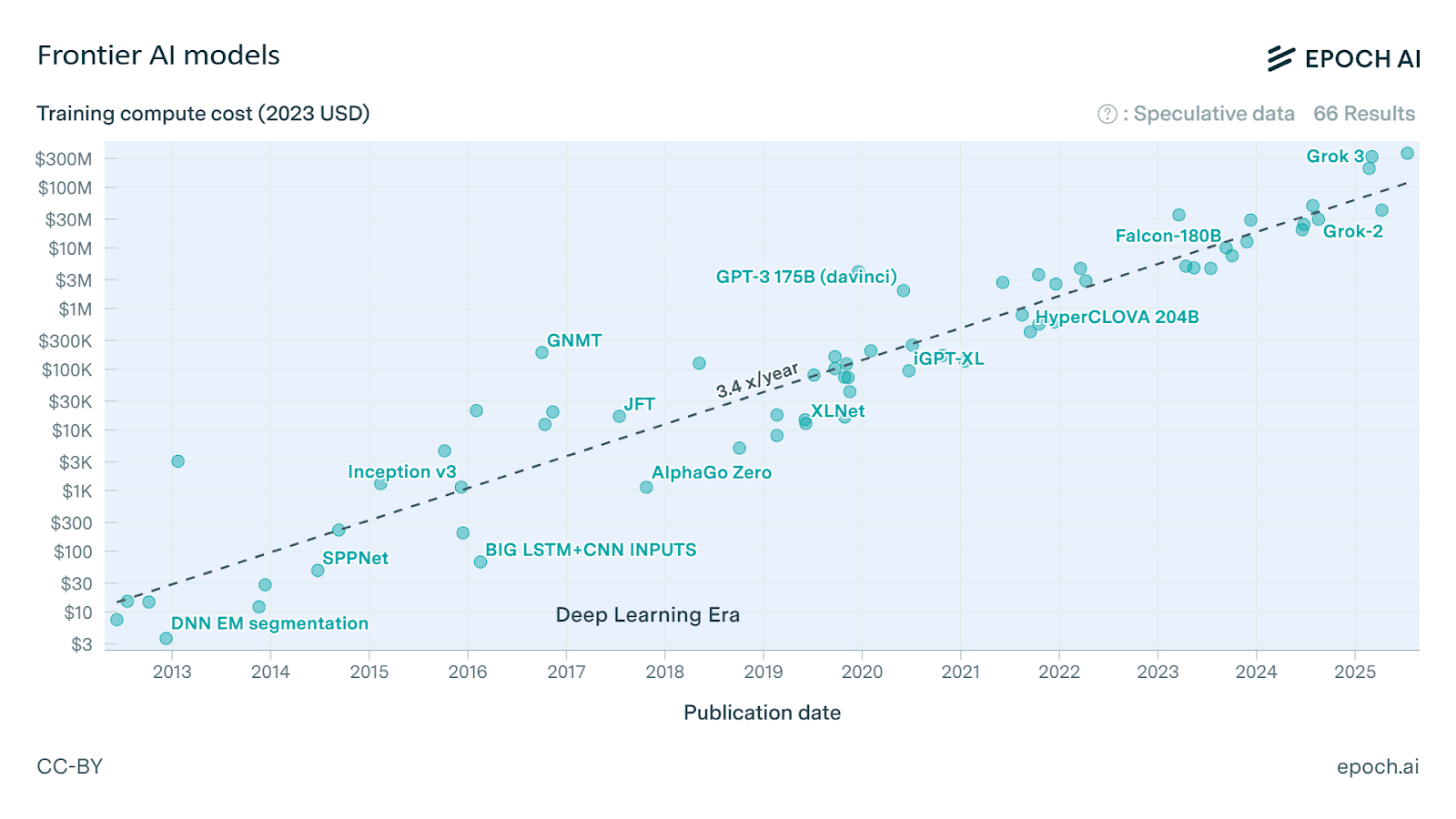
Continual learning will be necessary to fix these issues, though just how it’s applied will likely be an extensive engineering challenge. It will also bring AI much closer to something we might call “conscious,” as I’ve discussed previously. And if that wasn’t enough, it will also radically change the economics and operations of AI, removing the last remaining economies of scale since what was once one model will be split into multitudes and imply higher costs in compute, energy and cooling. Current AI frontier models have seen exponentially rising costs associated with compute as it is, note the log scale on this graph from Epoch AI.7
You should not expect that the LLM era will be a good guide to what comes when the era of the artificial universal machine begins. But you also should not expect the sort of AI takeoff which many in the industry are betting on. As another Epoch AI report shows, progress in Moore’s Law will likely not continue after the mid 2030s due to hitting the limits of atom sized manufacturing.8 It’s my personal belief that human evolution has probably pushed us as organisms very close to what is feasible in terms of intelligence, and that when we move to the general case of the universal machine, we will not see AI begin to exponentially self-improve once they reach our level, but rather plateau.
The logic of this plateau is somewhat intrinsic to the logic of intelligence qua a system of signs. Let’s return to the equation set out in the last blog which laid out the foundation for the structural linguistic estimate of human compute:
Computation per sign input = ((n*(n-1))/2)*((n*(n-1))/2) or ((n*(n-1))/2)^2 where n is the number of signs in the semiotic field.
This equation was based on the structural linguistics notion that the meaning of one sign, as both signifier and signified, effects the meaning of all other signs through its correlations and anti-correlations, which gives us the term (n*(n-1))/2), the equation for the number of unique connections between one item in a set and every other item. This term is doubled to express the dynamism of this semiotic field, which is constantly shifting with every use, equivalent to training in artificial neural networks.
This equation has a few peculiar properties. As the size of the semiotic field increases, the computational cost of processing signs increases exponentially. If we accept that intelligence is equivalent to the number of signs one can create and hold in memory, then a linear increase in intelligence would require an exponential increase in computation. I believe there is some empirical evidence for this principle. Epoch AI, for example, indicates that there has been a linear advancement in AI the past 3 years in its index of AI benchmarks,9 but there has been an exponential increase in compute and compute costs.10 Indeed, linear progress with many benchmarks has required an exponential increase in computation (note closely which axes are using log scales in scaling law charts).11 The increase in FLOPs used to train cutting edge models has gone up by two orders of magnitude since 2023, and certainly there have been big improvements, but are models really 10,000% as intelligent as they were in 2023? Probably not. But I would buy that they’re about 200% as intelligent as they were in 2023, which is roughly what the difference in the size of the semiotic field implied by those changes in compute. This would suggest, for example, that even if recursive self improvement was unlocked, it would lead to linear, rather than exponential growth in capabilities. And in nature, almost every exponential curve you encounter is really a future sigmoid.
If Epoch AI is correct that Moore’s law bottoms out in the early 2030s, then we’ll be left in a situation where human level AI may exist, but is extremely difficult to commercialize. The next century of technological development will be a story of overcoming those engineering challenges to bring the 2030 supercomputer level compute to consumers even as supercomputer development itself slows to a crawl. Traditional LLM development without continual learning, even as the semiotic field expands beyond human size, will undoubtedly create qualitatively new capabilities, but will be unable to actually produce a universal machine capable of automating all human labor. Such traditional LLMs have the luxury of leveraging FLOPs rather than FLOPS, trading space for time, in their training, but as the CEO of anthropic has acknowledged, there will be decreasing returns to scale for this, and indeed for intelligence in general.12
Nature appears to be conspiring to trap artificial intelligence at a similar level to human intelligence, most likely, in my opinion, due to the heroic efforts billion years of evolution has made to get humans this far. Once you surpass human level intelligence, Landauer heat starts to become a serious issue, if AI hardware continues to have that 200,000 to 1 ratio of FLOPS to logical operations at that point, the Landauer related power for human level AI will be close to 30,000 watts (three times that of Watt’s 1778 steam engine!). Even if something closer to the minimum of 409 to 1 was achieved, Landauer heat will grow at the same rate as FLOPS, meaning the exponential growth required to achieve linear growth in intelligence will entail exponential production of heat and with it cooling costs. Attempts to overcome this problem with reversible computing, I suspect, will prove to be temporary fixes due to the fundamentals of the second law of thermodynamics and the logical necessity of preventing Maxwell’s demon from being a free energy machine.
All of which isn’t to say that it will be impossible for machines smarter than any human to be built. But I would offer that the existence of such machines would not necessarily entail the economic or otherwise obsolescence of the human machine, even according to the cold calculating logic of capitalism. Any machine capability which exceeds a human’s natural ability qualitatively can be used as a tool by a human, assuming the supply chains and habitat which support human existence is still around, the costs of reproducing humans are in someways a sunk costs, and the active biological subsistence costs are exceedingly low, only a few dollars a day, presumably even cheaper in the future. Compare this to artificial universal machines which need an active demand signal for fixed capital investment, and necessarily have exponentially higher costs for marginally higher intelligence.
These dynamics suggest what is perhaps an underrated scenario in AI debates: a near simultaneous achievement of artificial general intelligence and the popping of the AI bubble as the real cost associated with AGI are understood. Already the stock market is beginning to balk at the capital expenditures required to continue this exponential increase in compute. There is no machine god waiting on the other side of AGI, no magic fix to every human problem, certainly no exponential growth hack. But there is yet the startling possibility of real non-human intelligence and even consciousness. And there is a real precipice we are approaching, in many ways totally unprepared, of someone actually “being home” inside the computer.
If it is true that much of human innovation and general labor capabilities comes from micro linguistic evolution, then it would be a practical impossibility for universal machines to be useful being used in the way contemporary LLMs are being used, prompted out of the ether to solve random problems. The universal machine would be needed to be embedded in long term human contexts in real time in order to move with this linguistic evolution and maximally contribute to work based upon it, this would also mean that machines working in different contexts may not be easy substitutes for each other, much as humans are not without extensive training. Capital will naturally treat these universal machines as disposable as any other machine or indeed employee. The real potential of these machines will be limited under capitalism, where irrational investment cycles and rent seeking will prevent the full integration of such machines into human social reproduction in a positive way. In certain periods of development they will almost certainly lead to immiseration of the working class, and will find key uses as tools of social control by the ruling class and the state apparatus.
All of which is to say, yes we are on the precipice, although not the precipice everyone seems to think we’re approaching.
Addendum:
It was brought to my attention that my new calculations for the Landauer heat based estimate also have an error. 2000 cm^2 are .2 m^2 rather than 20, which would dramatically bring down the output in Watts. So low, in fact, that it would seem to disagree with the previous estimates in the literature for Landauer based upper bounds of compute: 2–3 × 10^17 FLOPS, rather than the 5*10^19 or 2*10^20 found in the literature after converting them with the 409 logical operations to 1 FLOPS ratio. I was forced to look into the methodology for these previous studies and realized I might have been going about this the wrong way. I’m sorry to say that neither physics nor unit conversions are particularly my forte. See, the Landauer heat has to be included in the power budget for the computer, it is a certain share of the input watts, rather than a separate byproduct as I was treating it. This of course makes sense in retrospect, if you could get more power our than you put in, that’d also break thermodynamics. In other words, it made no sense for my measures of human Landauer heat output to produce watts greater than the overall input of watts to the brain, which is believed to be between 10-20. To get the compute estimate in logical operations per second, you’d just divide that watts figure by 1.3*10^-21 joules, the Landauer limit at human body temperatures. As usually, I’ve greatly overcomplicated things. Thank you to vantablight for pointing out my mistake, it’s actually always my secret hope that someone read my work and sorts out where I went wrong as its a bit of a shortcut to intellectual progress.
Zhu, Mingming, Joseph J. H. Ackerman, Alexander L. Sukstanskii, and Dmitriy A. Yablonskiy. 2006. “How the Body Controls Brain Temperature: The Temperature Shielding Effect of Cerebral Blood Flow.” Journal of Applied Physiology 101 (5): 1481–88. https://doi.org/10.1152/japplphysiol.00319.2006.
Chauhan, Pradip, Kinjal Jethwa, Ashish Rathawa, Girish Chauhan, and Simmi Mehra. 2021. Cerebral Ischemia. Exon Publications EBooks. Exon Publications. https://doi.org/10.36255/exonpublications.cerebralischemia.2021.
“Binary Additions Using Logic Gates.” 2018. 101 Computing. January 4, 2018. https://www.101computing.net/binary-additions-using-logic-gates/.
GeeksforGeeks. 2024. “Implementation of XOR Gate from NAND Gate.” GeeksforGeeks. March 11, 2024. https://www.geeksforgeeks.org/digital-logic/implementation-of-xor-gate-from-nand-gate/.
Dongarra et al. (2025) – with major processing by Our World in Data. “Computational capacity of the fastest supercomputers” [dataset]. Dongarra et al., “TOP500 Supercomputer Lists (1993-2025)” [original data]. Retrieved February 23, 2026 from https://archive.ourworldindata.org/20260202-130411/grapher/supercomputer-power-flops.html (archived on February 2, 2026).
Epoch AI, ‘Data on Machine Learning Hardware’. Published online at epoch.ai. Retrieved from ‘https://epoch.ai/data/machine-learning-hardware’ [online resource]. Accessed 23 Feb 2026.
Epoch AI, ‘Data on AI Models’. Published online at epoch.ai. Retrieved from ‘https://epoch.ai/data/ai-models’ [online resource]. Accessed 23 Feb 2026.
Marius Hobbhahn and Tamay Besiroglu (2022), “Predicting GPU performance”. Published online at epoch.ai. Retrieved from: ‘https://epoch.ai/blog/predicting-gpu-performance’ [online resource]
Epoch AI, ‘AI Benchmarking Hub’. Published online at epoch.ai. Retrieved from ‘https://epoch.ai/benchmarks’ [online resource]. Accessed 23 Feb 2026.
Epoch AI, ‘Data on AI Models’. Published online at epoch.ai. Retrieved from ‘https://epoch.ai/data/ai-models’ [online resource]. Accessed 23 Feb 2026.
David Owen. ‘How predictable is language model benchmark performance?’. ArXiv [cs.LG], 2024. arXiv. https://arxiv.org/abs/2401.04757.
Dwarkesh Patel. 2026. “Dario Amodei — ‘We Are near the End of the Exponential.’” YouTube. February 13, 2026.
As a computational neuroscientist, I am a firm hater of arguments that use brain FLOP estimates to do AI forecasting for two reasons:
1) Every estimate of the computational power of the brain is an underestimate. These arguments assume that biological neural networks are more-or-less like artificial neural networks. Biological neurons not only express the dynamics of artificial networks but also interact with neuromodulatory systems, hormones, epigenetic configurations, and networks of glial cells. When accounting for only some of these factors, one researcher needed a deep neural net of five layers to approximate the dynamics of one cortical neuron (https://www.sciencedirect.com/science/article/pii/S0896627321005018).
This *could* make you skeptical of silicon every being able to approximate human intelligence. This is sort-of-true, except:
2) AI has completely different limitations and goals than biological neural systems. Brains need to modulate blood pressure and appetite, manage a constant stream of multi-sensory input, generate moods, maintain consciousness, etc. I do not see why AI would need to do any of this to have human-level capabilities at coding, science, or to be a general purpose language machine. This means that whatever FLOPs we estimate human brains to have really tells us very little about what the minimum amount of computational resources are required for AI to have transformative impact.